



Introduction
As parents, we’ve all heard it: “Reading is the foundation of learning.” And it’s true. The ability to read confidently doesn’t just open doors to stories and textbooks; it opens the world. It shapes how children learn in school, how they think critically, and even how they express themselves. Naturally, every parent wants to give their child the best start possible when it comes to literacy.
But here’s the challenge: there are countless teaching methods out there, each promising the fastest, most effective path to reading. Among them, the Montessori approach—with its unique blend of independence, structure, and respect for a child’s natural development—has stood the test of time. And when paired with the proven effectiveness of phonics, the result is
a powerful and child-friendly way to nurture strong, confident readers.
So what exactly is the Montessori phonics and reading approach, and why are so many
parents in Singapore (and worldwide) drawn to it? Let’s take a closer look.
The Roots of Montessori Education
Montessori is more than just a buzzword attached to preschools. Developed by Dr. Maria Montessori in 1897, the method is grounded in the belief that every child is naturally curious, capable, and eager to learn—when given the right environment. Instead of forcing children into rigid molds, Montessori education emphasizes independence, hands-on discovery, and learning at a pace that suits each individual.
When it comes to reading, this means children aren’t drilled with endless flashcards or
pressured into memorizing words before they’re ready. Instead, they are gently guided through a journey of sound, movement, and meaning—one that builds literacy step by step, while also nurturing confidence and joy in learning.
Why Phonics Matters
At the heart of the Montessori reading method is phonics. Phonics is the practice of teaching children the relationship between sounds (phonemes) and letters (graphemes). In simpler terms, it helps children understand that letters are not just squiggles on a page—they represent sounds that can be blended together to form words.
Research consistently shows that phonics is one of the most effective ways to teach children how to read. Instead of memorizing entire words by sight, children equipped with phonics skills can decode new words on their own. This means greater independence, less frustration, and a strong foundation for lifelong reading.

The Montessori Twist: Multi-Sensory Learning
What makes the Montessori phonics approach so effective is its multi-sensory design. Children don’t just see letters—they touch, trace, hear, and even say them.
Take the famous sandpaper letters, for example. These are tactile cards with rough-textured letters that children trace with their fingers while saying the corresponding sound aloud. This simple yet brilliant tool engages multiple senses at once—sight, touch, and hearing—helping children lock in the connection between letters and sounds.
By engaging the whole body in the learning process, Montessori makes reading less abstract and far more concrete for young minds.
Step by Step: How Montessori
Builds Reading Skills
Montessori’s approach to phonics and reading is carefully sequenced, ensuring that children
build on success rather than stumble on frustration. Here’s how it typically unfolds:
- Sound Awareness – Before letters are even introduced, children are trained to listen closely to sounds in words. For example, they might play games where they identify the first sound in “ball” or the ending sound in “cat.” This sharpens their auditory awareness, a crucial pre-reading skill.
- Sandpaper Letters – Next, children are introduced to individual letter sounds using tactile materials.
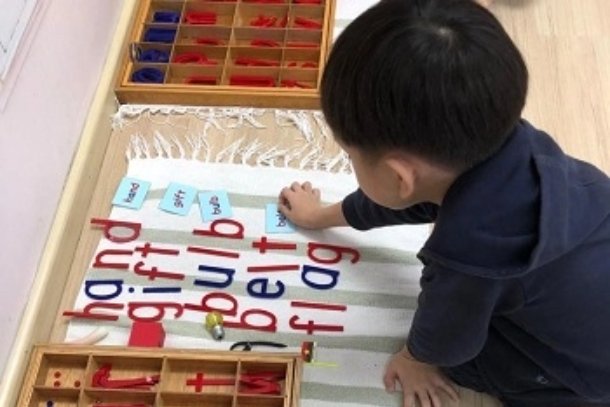
- The Movable Alphabet – This Montessori material allows children to “write” words using cut-out letters before they can physically write with a pencil. For instance, a child who knows the sounds /c/, /a/ and /t/ can arrange them to form “cat.” This makes spelling and word formation accessible at an early stage.
- Blending and Reading Words – Once children are comfortable with individual sounds, they learn how to blend them into simple words. Because they’ve practiced with the movable alphabet, this transition often feels natural and exciting.
- Reading for Meaning – Finally, once decoding skills are strong, children move into reading short stories and passages. The emphasis is not just on “sounding out” words, but on understanding and enjoying the story.
Why It Works So Well
Parents often ask: Why not just use flashcards or memorization? Isn’t faster better?
The truth is, memorization might give the illusion of early reading, but it rarely lasts. Children can only memorize so many words before they hit a wall. Phonics, especially the Montessori way, equips them with the tools to decode any word they encounter. This builds true independence.
Even more importantly, the Montessori phonics approach fosters a love of learning. Instead of feeling pressured or compared, children experience the thrill of discovery at their own pace. They feel empowered, not overwhelmed—and that confidence carries over into every other subject.
How Parents Can Support at Home
- Focus on sounds, not letter names. When introducing “m,” say “mmm,” not “em.” This keeps things clear for young learners.
- Play listening games. Ask your child to find objects around the house that start with a certain sound.
- Make it tactile. Use textured letters, magnetic alphabets, or even write letters in sand or flour for a sensory-rich experience.
- Keep it fun. Read aloud daily, point out words in the environment, and celebrate small victories.
Choosing the Right Montessori School
- Multi-sensory phonics materials like sandpaper letters and the movable alphabet.ounds, not letter names. When introducing “m,” say “mmm,” not “em.” This keeps things clear for young learners.
- Individualized pacing instead of rigid, one-size-fits-all lessons.
- A calm, child-centered environment where children explore independently.
- Guides (teachers) who observe and support, rather than lecture and control.
The Gift of Reading for Life
At the end of the day, teaching a child to read is about more than decoding words. It’s about giving them the confidence, curiosity, and joy to explore the world through books. The Montessori phonics and reading approach respects the child’s natural rhythm, making learning a delightful journey rather than a pressured race.
For parents, this means peace of mind—knowing that your child is not only learning how to read, but also developing the independence and love of learning that will serve them for life.
Because isn’t that what we all want? Not just children who can read early, but children who will read forever.